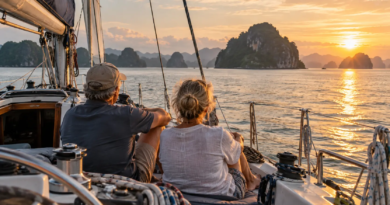
Sailing Red Seas: From Scotland to the Seven Seas: Iain & Brioni’s Voyage of Reinvention
A Scottish couple who sold everything to sail the world, documenting their journey through highs, lows, and the vastness of open sea.
Iain and Brioni took a leap that many only imagine: they sold everything, bought a catamaran, and left land behind. Their YouTube channel, Sailing Red Seas, documents that transition. From ocean crossings to mechanical failures, and from remote island anchorages to bouts of deep uncertainty, their journey is both adventurous and grounded in daily realities. What sets them apart isn’t just the destinations, but how they bring viewers into the process of becoming full-time liveaboard sailors.
At-a-Glance
- Web Name: Sailing Red Seas
- Names: Iain & Brioni
- Generation: Gen Y
- Travel Type: Full-time sailing on a 47-foot catamaran
- FI Status: Self-funded through content creation and sponsorships
- Travel Regions: Pacific Ocean, including French Polynesia and the Gambier Islands
- Media Platforms: YouTube, Instagram, Patreon
🖙
Backstory
Before becoming full-time sailors, Iain and Brioni lived a typical life in Scotland. Iain worked in engineering, and Brioni held various roles in education and design. Like many others, they found themselves wondering what life would look like if they stripped away obligations and routines. That wondering became a plan, and eventually a boat. In 2019, they sold their house, left their jobs, and bought a sailing catamaran despite minimal experience. Their learning curve has been steep and public. They chose the name Red Seas both as a nod to their shared red hair and as a playful reminder of the unpredictability of life at sea.
The Shift
The moment of change was less a single decision and more an unfolding. For Iain and Brioni, dissatisfaction was a quiet sense of misalignment. Life was comfortable, but not expansive. They wanted movement, challenge, the unknown. They chose a boat not because they were natural sailors but because the sea offered a canvas large enough to reimagine how they lived. The shift has not just been logistical but internal. Sailing is not passive travel. It demands awareness, adaptability, and physical presence. Brioni often reflects on this in their videos by not romanticising the lifestyle and revealing how it carves away the excess.
How They Made It Work
Their boat is their home, studio, and livelihood. Early on, they funded the venture through savings and by downsizing their lives entirely. Since then, they’ve developed a patchwork income: YouTube ad revenue, Patreon memberships, occasional merchandise sales, and downloadable digital content like hand-illustrated colouring books. They manage their budget with care, anchoring in bays, rather than docking in marinas, doing their own repairs (like removing both engines & replacing with new), and delaying luxuries. It’s a transparent model of slow, supported travel that works because it’s intentionally lean. *
Where They Travel & Why
Their sailing journey has been shaped as much by weather and logistics as by desire. They began in the Caribbean, gradually moving westward into the Pacific. Places like French Polynesia and the Cook Islands feature heavily in their content, not just for their beauty, but because these are the places that offer anchorage, isolation, and stories. They are drawn to remote islands where community life is intact and cruisers are a curiosity rather than a crowd. Their reasons for travel are layered: to explore, to test themselves, to connect with the ocean, and to continue the narrative they began when they untied the dock lines in 2019.
Challenges & Real Talk
Their videos are refreshingly honest about the physical and mental load of full-time sailing. Like all sailing vessels the catamaran needs constant upkeep; sails tear, water-makers break, engines overheat . . engines need replacing! On one passage, a torn genoa forced them to slow significantly, adding days to a journey. Another time, they discovered a hole in their fuel tank mid-crossing. Their boat becomes a metaphor: when something fails, you pause, you fix, you adapt. Emotionally, too, the lifestyle isn’t idyllic. They’ve spoken about isolation, interpersonal strain, and decision fatigue. But this is where their appeal lies: they let viewers in not just on the triumphs, but the trade-offs.
What Keeps Them Going
What sustains them is not adrenaline or aesthetics, but something quieter: the rhythm of the ocean, the satisfaction of problem-solving, the richness of seeing a place slowly. Over time, the boat has become more than a vessel. It’s an evolving companion in their pursuit of a different kind of life. Brioni, often the more reflective of the two, shares moments of calm joy that hint at a deeper commitment: not just to travel, but to a redefined version of success. For Iain, the drive comes from building competence where each challenge solved adds to the sense that they are not just surviving, but thriving afloat.
Advice to Readers
Iain and Brioni don’t offer shortcuts. Instead, their advice comes through lived detail. Start with one skill, maybe navigation, maybe engine mechanics, provisioning. And build from there. Don’t wait for complete readiness; learn as you go. Financially, they urge people to run lean: cut recurring costs, do more yourself, and be transparent with your community if you share content. Most importantly, they stress emotional preparedness. Sailing, like any life reimagined, reveals who you are when things get hard. That’s where the real growth happens.
Links to More
(*) Disclaimer: Income stream and Financial Independence (FI) details are drawn exclusively from publicly available sources. No inference, harm, or misrepresentation is intended toward any individual or entity.