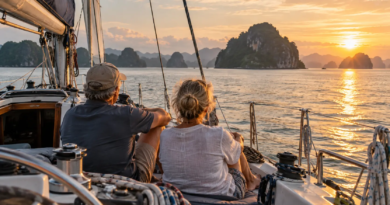
Case Study : How An Aussie Couple Became ‘Sailing AB Sea’
An Australian couple in their fifties transformed a casual idea into a bold new life, learning to sail, relocating to Europe, and buying a yacht to begin their Mediterranean adventure.
Fina Road Profile: ABSea: Sailing into a Life of Their Own
The Idea was born
On July 31, 2016, Barry was aboard a friend’s motorboat off the Queensland coast. The water rolled in long, lazy swells, the winter sun low but warm. From the bow, the shoreline was a pale strip in the distance. The sound of the engine filled the space between conversation. It was an ordinary outing, the kind that ends with a beer on shore and is forgotten by the next weekend. But somewhere in that stillness, the idea took hold. What if this, the water, the horizon, the sense of movement without a road beneath you, was not a day’s distraction but a way of living?
Back home, he put the idea to Aannsha. They were in their fifties, with a grown son and a settled life. The conversation began small: a sailboat for weekend diving trips, a modest vessel to extend their time on the water. But questions grew like branches. If we buy, where will we find value? If we live aboard, what size will we need? How do we learn enough to be safe?
A spreadsheet gave one answer fast: boats in Europe could be bought for tens of thousands less than in Australia . . . well, about 50k for the monohulls they were looking at. Another answer was equally persuasive: in the Mediterranean, they could train year-round. This wasn’t just a way to save money, it was a way to accelerate the whole plan. Geography could work for them if they were willing to shift their centre of gravity halfway around the planet.
The Plan is Executed
In late 2017, they committed. Their Queensland home became a worksite. Carpets were stripped, gardens tidied, walls painted. Furniture went on Gumtree; keepsakes into boxes. It was hard, physical work, but it was also mental preparation. Letting go of a house was practice for letting go of the stability it represented.
December brought the final act. The house sold, bags packed, they said a quiet farewell to their son at the airport. This was no holiday. A one-way flight to Alicante took them via long-haul stopovers they barely registered. On arrival, the Mediterranean light was different: softer in the morning, sharp-edged by midday, gold in the evening.
They based themselves in Jávea, a coastal town set between the Montgó massif and the sea. From here, roads ran to marinas in Denia, Altea, and Torrevieja. Each day offered the chance to step onto boats, speak with brokers, and walk the shoreline they might one day approach from the water. The plan, once just a list, now had a landscape. And in that landscape, their curiosity became a working tool.
The Learning
The second stage of their plan was to close the gap between liking the sea and being able to live by it. They chose Gibraltar as their training ground.
The drive south from Jávea took them past the Sierra Nevada, still holding snow, down to the narrow strip of land that joins Gibraltar to Spain. The Rock itself is both landmark and symbol; limestone rising from the sea, the meeting point of Atlantic and Mediterranean, of Europe and Africa.
Here they began the RYA Competent Crew course. For five days, they lived aboard an instructional yacht. The days were full: hoisting sails, taking the helm, steering to a compass course, securing lines, reefing in rising winds. Evenings were for cooking in the galley, tidying the deck, and logging the day’s run in pencil at the saloon table. Nights were for anchor watches and listening to the change in the wind through the rigging.
Passing the course meant they could be trusted crew, but their eyes were already on the next step. The Day Skipper theory course replaced halyards with chartwork. They plotted bearings, calculated tides, read weather patterns. Then came the practical: coastal passages, close-quarters manoeuvring, man-overboard drills. The Strait’s traffic lanes were busy with tankers, fishing boats, ferries. The wind funnelled through the gap between continents, shifting without warning. To pass here was to be tested in one of the most demanding sailing classrooms available.
Between courses, they returned to Jávea. They walked the ridge to the medieval windmills, their stone towers weathered by centuries of sea air. They stood at the Cap de Sant Antoni lighthouse, built in 1855, watching the water change colour with the depth. Playa de la Granadella’s sheltered cove became a place they imagined approaching under sail.
These were not idle excursions. Each place fixed itself in memory as a point of reference, a landmark, a depth change, a shelter. They were building not just skill but a personal chart of the coast. This was curiosity put to work, learning geography as an extension of seamanship.
Buying the Boat
By early 2018, their skills and their location aligned. They were ready to find the boat that would carry them forward. The search was a process of elimination.
They walked marinas from Valencia to Cartagena. Some boats looked promising on paper but failed the first inspection: decks soft underfoot, rigging slack, engines neglected. Others were sound but wrong for their needs, too small to live aboard, too large to handle as a couple.
In San Pedro del Pinatar, they found her. At Puerto Marina de las Salinas lay a 1995 Jeanneau Sun Odyssey 45.1. She was the right size, the right age, and within budget.
Due diligence meant a haul-out and full survey. The travel lift’s slings cradled her hull, lifting her clear of the water. Sunlight flashed on the wet antifoul as she swung gently. A marine surveyor moved along the hull, tapping with a mallet, listening for the dull change in tone that signals trouble. He checked keel bolts, rudder bearings, through-hulls, and anodes. On deck, he turned winches, inspected rigging, tested hatches and electronics.
The yard’s location was part of their calculation. Here, with the Mediterranean on one side and the sheltered Mar Menor lagoon on the other, marine service providers were close at hand. If repairs were needed, work could begin without moving her far. This was practicality and resourcefulness in geography, choosing not just a boat but the place where buying it made sense.
The survey came back clean. Papers were signed. Funds moved. She became A B Sea. The name would be painted on the stern, but in that moment, what mattered was the shift in identity: they were no longer people learning to sail, they were sailors with a vessel of their own.
They had left Queensland with a spark of an idea. In just over a year, they had sold their home, moved continents, trained in demanding waters, and bought a yacht in a foreign port. The Mediterranean was no longer an abstract promise. It was the water alongside their berth, the air they breathed each morning, the backdrop to a life they had built step by deliberate step.
The quiet moment on the motorboat in 2016 had travelled with them, shaping each choice. Curiosity had led them to ask the first questions. Resourcefulness had shaped their plan across continents. Resilience had carried them through the practical work of selling up, learning, and buying.
And now, the horizon they once imagined was the horizon they woke to, as real and present as the deck beneath their feet.
Lessons Learned
- Big changes begin with small, slightly ridiculous thoughts – “What if we just lived on a boat?” It seemed harmless enough at the time.
- Plans tend to grow when you’re not looking – A modest weekend sailing dream can quickly turn into a multi-year, multi-continent logistical undertaking involving a small fortune and several metric tons of paperwork.
- Geography affects your wallet – Boats in Europe cost less that Australia. It’s not romantic, but it is a fact. You can choose to ignore it, but your bank balance will just sit there raising an eyebrow.
- You can’t sort of move aboard a boat – At some point you have to leave the house, say goodbye to your sofa, and dive in.
- Downsizing is weirdly liberating – You realise you don’t need ninety percent of what you own. Of course, some of that ninety percent you’ll spend the next two years trying to replace at twice the price.
- Pick your base like you’re choosing a good neighbour – Access to marinas, repair yards, and a decent café is vital. The café is more important than you think.
- Learn the area before you float around in it – Coastal landmarks aren’t just pretty; they can tell you where you are, and more importantly, where not to be.
- Get trained by proper professionals – They learned to sail in Gibraltar, where the wind comes at you from all directions at once and the ships are the size of shopping malls.
- Hard training pays off – If you can dock in Gibraltar without crying, you can probably dock anywhere.
- Tie your learning to the landscape – Knowing that a lighthouse was built in 1855 doesn’t help you sail, but it does make you feel clever when you go past it.
- Boats are like people on dating sites – They often look better in photos. Meet them in person, kick the tyres (metaphorically of course), and see if they creak.
- Always get a survey – A professional will find all the things you didn’t even know could go wrong, which is equal parts reassuring and terrifying.
- Think beyond the boat – The marina’s facilities, local trades, and ability to find a spare part on a Sunday will shape your life more than the colour of the hull.
- Mark the moment – When you stop dreaming and start doing, you’ve crossed the invisible line from “someday” to “now.”