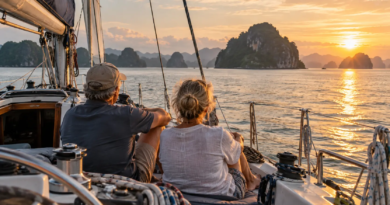
Pardey Time, A Life Built on Wind
Lin and Larry Pardey, America’s first couple of cruising.
Website: Pardey Time
Somewhere in the folds of nautical folklore and real-life resilience drifts the story of Lin Pardey. Not a tale of escape, but of deliberate pursuit. Of making a home with the wind, and keeping a steady course long after most would have dropped anchor. Her name may not dominate the trending pages of digital nomad forums or fill the thumbnails of YouTube’s vanlife vlogs, but in the world of serious cruising sailors, Lin Pardey is as close to ‘a serious sailor’ as one can get.
Born in the United States and eventually rooted in New Zealand, Lin’s sailing journey was not some grand rejection of the modern world, but a steady and considered walk away from it. In her early twenties, she met Larry Pardey, a man who had already begun to live by an unusual nautical code: sail without engines, build your own boats, and travel by the will of the wind. When the two met in California, their philosophies aligned. It was a romance of shared intention. Together, they chose a life that no one asked them to justify, and few would dare emulate.
They began by building Seraffyn, a 24-foot wooden cutter designed by Lyle Hess, the first of their two self-built boats. It was launched on Halloween 1968. Years later, they built Taleisin, a slightly larger 29-foot Hess cutter, launched in October 1983. Neither vessel carried an engine. Their belief was radical yet disarmingly logical: if sailors had crossed oceans long before combustion, why shouldn’t they? What followed was not a short sabbatical or a youthful stunt. It was decades of full-time voyaging.
Their logged mileage exceeds 200,000 nautical miles. That includes two full circumnavigations, one east-about & one west-about (heck, why not), and years of slow navigation through the Mediterranean, the Red Sea, the Pacific, and the coasts of South America. They often sailed against the prevailing winds to challenge themselves and to prove that a small, well-handled boat could outmanoeuvre larger, more complex yachts. Their journey was methodical, not meandering. They didn’t chase destinations: they built a life afloat.
What’s often missed in retellings of the Pardeys’ voyages is just how practical they were. The couple was frugal to the bone, in a working-class, make-do way. They cooked on kerosene stoves, used hand-pumped water, and navigated by celestial means before GPS became mainstream. Their first long voyage was funded by writing articles and repairing sails. Later, their book royalties and instructional videos provided modest income. They were pioneers of slow travel not by branding, but by default.
Yet, despite their anti-commercial stance, the Pardeys did become known. They authored a series of respected books, among them “Cruising in Seraffyn”, “Seraffyn’s Oriental Adventure”, and “The Capable Cruiser”, are all widely read within the cruising community. Lin became a sought-after speaker at sailing seminars, and together they were inducted into the Cruising Club of America’s pantheon of respected voyagers. But fame, when it came, was never the point. They shared knowledge because it was part of the ethos: pass it on, so others may go.
By the late 1990s, they had slowed their sailing and moved ashore, settling on Kawau Island, New Zealand, a rugged and lush enclave accessible only by water. Their home was a classic cottage with its own jetty, and became a hub for wooden boat lovers and sailors passing through. But their retirement was only partial. Lin continued to write, to host sailing apprentices, and to document their voyages for new generations.
Larry Pardey suffered a stroke in the 2010s and passed away in 2020. The loss was profound, and Lin wrote about it with clarity and grace. But she did not let that loss define her future. She began a new chapter, continuing to sail aboard a steel cutter named Sahula alongside a new sailing partner, David. Their voyages took them to Tasmania, Vanuatu, and up the Queensland coast. These weren’t farewell cruises. They were continuations of a life that never made a distinction between work and leisure, between adventure and routine.
The blog, Pardey Time, documents all of this. It is less a travelogue and more a ledger of choices made, skills learned, and the slow unfolding of a life afloat. Unlike modern influencer feeds, it isn’t designed for visual impact. Instead, it rewards readers with detail: hull refits, storm strategies, the etiquette of mooring in crowded bays. It is rich with personality, but also humility.
What stands out most is Lin’s steady tone. She doesn’t sell sailing. She explains it. She doesn’t idealise life aboard—she contextualises it. There are posts about loneliness, about the quiet satisfaction of a good varnish job, about learning to cohabitate in tight quarters without mutiny. She reflects on ageing not as limitation, but as a recalibration of tempo. As if even life’s final passages can be navigated with sail trim and plotted waypoints.
There are few people who’ve lived this way for over five decades and even fewer who’ve chronicled it without embellishment. Lin Pardey has done both. She is part cartographer, part chronicler, part craftsman. Her legacy is not just in the miles sailed or the books written, but in the permission she grants others; the permission to go their own way, to trust in skills over gadgets, to believe that a small, seaworthy boat is enough.