
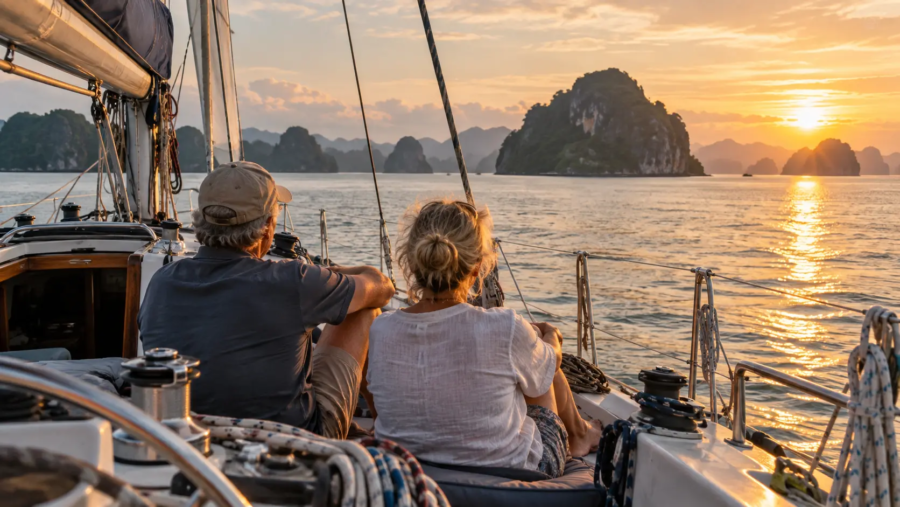
Dreamtime Sail: Rob & Karen Oberg Chose Another Way to Get to Sea
When the financial plan behind their sailing life stalled, Rob & Karen Oberg changed the plan rather than abandoning the journey.
Their route to long-term cruising began with a problem. They wanted a yacht and a life at sea, but the financial strategy intended to make it happen stopped working. Their answer was to find another way aboard.
At-a-Glance:
Web Name: Dreamtime Sail
Name: Rob & Karen Oberg
Generation: Gen-X
FI status: Built around property: selling their family home, renovating houses, rent income.
Travel type: Long-term sailing and cruising, initially as crew on other people’s yachts and later aboard their own Whitby 42 ketch, Our Dreamtime.
Travel Regions: Australia, South-East Asia, the Mediterranean and parts of southern Europe and North Africa.
Media Platforms: Dreamtime Sail blog, Facebook, Instagram and YouTube. They also publish books and sailing guides.
Backstory:
Rob & Karen Oberg describe themselves as an Australian couple who had become tired of the conventional nine-to-five pattern and wanted to explore the world under sail. They were empty nesters when they began putting practical foundations underneath that ambition.
The plan involved property. They sold their large family home, bought and renovated three houses, and intended to retain two as rentals while selling the third to finance the purchase of a cruising yacht. It was a deliberate attempt to create both an income source and the capital needed for their next stage of life.
Timing intervened. Their account describes the Global Financial Crisis and severe natural disasters in Queensland depressing the property market just as they needed to sell. The financial mechanism underneath their sailing plan had stalled.
That detail makes their story particularly relevant to Fina Road.
Their transition didn’t begin with perfect finances, a newly purchased yacht or decades of sailing experience. The original plan encountered circumstances beyond their control.
Rob & Karen’s subsequent decisions provide the more useful part of the story: they separated the objective, living a cruising life, from the particular method they had originally chosen to reach it.
The Shift:
June 2011 became the beginning of a different version of their plan.
Instead of waiting until they could purchase the yacht they had imagined, Rob & Karen looked for crewing positions aboard boats belonging to other people. Their first extended experience took them around northern Australia and through Indonesia towards Bali aboard a Beneteau 57. They subsequently joined a Formosa ketch bound for Borneo and Malaysia, followed by participation in Thailand’s King’s Cup Regatta aboard another yacht.
The approach achieved two things simultaneously. They were travelling under sail, and they were accumulating experience.
Their first year of crewing eventually covered around 7,200 nautical miles across South-East Asia and Europe. They later sailed in the Mediterranean for two seasons aboard the Jeanneau 43 DS Alcheringa with crewmate Marc Beerts.
The shift is important because the destination in their thinking remained remarkably consistent while the mechanism changed.
Owning a yacht had originally appeared to be the gateway into cruising. Crewing showed them that access to the lifestyle could come first.
That experience also changed the practical foundation of what followed. A couple who had begun with limited sailing experience accumulated thousands of miles at sea before eventually becoming long-term owners and cruisers themselves.
Their next adventure had already begun before they possessed the boat intended to make it possible.
How They Made It Work:
The Obergs’ early strategy combined property, future rental income and the planned sale of an investment property. Their own account makes clear that this was intended to provide both ongoing income and the money required to purchase a yacht.
When property conditions disrupted that plan, they substituted access and experience for immediate ownership.
They also invested in knowledge. Their published account says they completed a range of Royal Yachting Association courses while preparing for life at sea. Crewing then turned formal learning into practical experience across very different boats and sailing conditions.
After their initial South-East Asian sailing, they travelled to Europe and sought heavy-weather experience aboard a Shipman 72, sailing from northern Italy through Malta, Tunisia, Sardinia, Mallorca and the Spanish coast.
Eventually ownership returned to the story.
After leaving Alcheringa in Sicily and returning to Australia in 2013, they began searching for a boat suitable for extended cruising in the western Pacific and South-East Asia. They acquired a Whitby 42 ketch and renamed her Our Dreamtime.
Their public work has since expanded to include books, ebooks, sailing guides, video and reader-supported creative work through platforms including Patreon and Ko-fi. The available material establishes these as current activities, although it doesn’t establish how much each contributes to financing their overall lifestyle.
Where They Travel & Why:
The geography of Dreamtime Sail has expanded considerably from those first crewing passages.
Rob & Karen’s sailing has included Australia, Indonesia, Malaysia, Thailand, Italy, Malta, Tunisia, Sardinia, Mallorca, Spain and other Mediterranean cruising areas. After acquiring Our Dreamtime, they cruised extensively along Australia’s Great Barrier Reef before returning to South-East Asia.
By the most recent material on their blog, they had accumulated 24,273 nautical miles and were sailing in South-East Asia. In May 2025 they reported reaching Bau Bau in Indonesia after extended cruising through the region.
Their published material suggests that the places themselves are only part of the attraction. Their accounts repeatedly document the mechanics of living aboard: weather, anchorages, maintenance, passages, local communities and the long stationary periods that form part of cruising.
Karen has also written about the importance of hobbies aboard a cruising yacht. Much of cruising life, she observes, is spent at anchor rather than sailing. Activities away from the helm become part of adjusting to a changed daily rhythm.
That distinction matters.
Long-term cruising creates another form of ordinary life. Boats need maintenance. Supplies need replenishing. Visas need extending. Weather changes plans. Days are spent waiting.
Travel becomes a place to live rather than simply somewhere to visit.
Challenges & Real Talk:
Dreamtime Sail contains plenty of evidence that long-term sailing has remained unpredictable.
The first major setback happened before Rob & Karen properly started. Their property strategy ran into the combined effects of the Global Financial Crisis and Queensland’s natural disasters. The boat they expected to buy remained beyond the reach of their original timetable.
Once at sea, uncertainty simply changed form.
Their archive records difficult passages, equipment work, weather delays and potentially dangerous situations. At Lady Musgrave Island in 2020, for example, they described a powerful current carrying Our Dreamtime dangerously towards coral before they escaped the situation.
COVID-19 also disrupted their cruising plans, while the practical work of maintaining an ageing yacht has remained part of the lifestyle. Their Whitby 42 was already a mature cruising boat when they bought it, and their blog documents refurbishment and ongoing maintenance alongside passages and destinations.
Their recent Indonesian writing offers a quieter version of the same reality. Reaching Bau Bau involved visa extensions, provisioning and ensuring they carried enough cash for areas where card facilities would be scarce.
These details give the lifestyle its scale.
Twenty-four thousand nautical miles contain remarkable places. They also contain administration, maintenance, waiting, changing weather, financial decisions and mistakes.
That ordinary work is part of what makes the journey credible.
What Keeps Them Going:
More than a decade separates the Obergs’ original attempt to finance a yacht from their recent passages through Indonesia.
Continuity is perhaps the strongest feature of their story.
Their travelling life has changed shape several times: aspiring yacht owners, volunteer crew, Mediterranean cruisers, boat owners, Australian coastal sailors and eventually long-term international cruisers aboard Our Dreamtime.
Their blog has changed with it. What began as documentation of getting to sea has become a large archive of passages, practical sailing material, cultural encounters, boat work, food, art, video and cruising guides.
By 2023 and 2024, one Indonesian journey alone covered 5,939 nautical miles over 423 days, according to their description of the route accompanying their Follow in Our Wake Indonesia guide.
The pace of this life is equally revealing.
There are passages measured in thousands of nautical miles, followed by days dealing with paperwork or waiting for suitable conditions. There are dramatic encounters at sea alongside afternoons devoted to reading, sketching, swimming or simply remaining at anchor.
Long-term travel has become their normal rhythm.
That may be the clearest evidence of the transformation: the adventure survived long enough to become everyday life.
Advice to Readers:
Rob & Karen’s strongest practical lesson comes directly from the way they began.
When buying their own yacht became financially impractical on the original timetable, they found crewing positions instead. Their book describes this as the decision behind its title, Stuff it. Let’s go sailing anyway. Crewing allowed them to begin travelling while building substantial sailing experience on boats belonging to other people.
Their subsequent history also supports the importance they placed on gaining skills. They undertook RYA training and deliberately sought different sailing conditions, including winter and heavy-weather experience in Europe.
Their current writing adds another practical theme: prepare for the mundane parts of extended cruising as carefully as the passages. In Indonesia that has meant managing visas, supplies, access to cash and seasonal sailing conditions. Their cruising guides grew directly from recording the contacts, fuel stops, markets and local information they found useful along the way.
The useful principle in their own record is adaptability.
Their original plan changed. Their desired life remained sufficiently important for them to find another workable route towards it.
For a reader wondering whether a long-held plan has become too difficult, too expensive or simply mistimed, Dreamtime Sail offers a documented example of re-authoring the route rather than surrendering the destination.
Links to More:
Dreamtime Sail: dreamtimesail.blogspot.com
YouTube: Dreamtime Sailing
Facebook: Dreamtime Sail
Instagram: Dreamtime Sail
Their blog also links to the Dreamtime Sail YouTube channel and their published books and cruising guides.
Rob & Karen Oberg began with a recognisable desire: create enough financial autonomy to choose what came next. When the financial mechanism behind that plan faltered, they changed the mechanism. Crewing led to experience, experience led to ownership, and ownership developed into years of long-term cruising.
Their story brings the Fina Road ideas of autonomy, identity and life reimagined into something concrete: a next adventure doesn’t always begin when every part of the original plan finally works. Sometimes it begins when people recognise that the plan itself can be rewritten.
Disclaimer: Income, income streams and financial independence details & status are drawn exclusively from publicly available sources. No inference, harm, or misrepresentation is intended toward any individual or entity.


